






Some links on this page are partner links. They never change what we recommend. How we pick →
How to Start an LLC in 2027 (Step by Step)
Eight steps from idea to a working LLC, the fees six big states charge (read on their own websites), and what the Tailor Brands sign-up actually looks like, screen by screen.
Gear Receipts Desk· 14 sources read· Updated Nov 27, 2026
To start an LLC, you pick a state, choose an available name, name a registered agent, file Articles of Organization with the state and pay its fee, write an operating agreement, then get a free EIN from the IRS. State filing fees run from $35 to $500. You can file yourself or let Tailor Brands do it from $0 plus the state fee.
Lite plan: $0 plus your state's filing fee. You answer the questions, they file.Jump to a section
state filing fee in most states
Receipt · Tailor Brands: How to start an LLC$35–$500 state filing fee in most statesRead Nov 27, 2026Open source ↗for an EIN straight from the IRS
Receipt · IRS: Get an employer identification number$0 for an EIN straight from the IRSRead Nov 27, 2026Open source ↗Tailor Brands Lite plan, plus the state fee
Receipt · Tailor Brands pricing page$0 Tailor Brands Lite plan, plus the state feeRead Nov 27, 2026Open source ↗California's annual LLC tax, the big one to plan for
Receipt · California Franchise Tax Board: Limited liability company$800 California's annual LLC tax, the big one to plan forRead Nov 27, 2026Open source ↗Informational only, not legal or tax advice. Fees and rules change: check your state's official website or a licensed professional before you file.
Watch it step by step
What is an LLC, and do you need one?
A limited liability company (LLC) is a business structure that keeps your personal assets separate from your business's debts and legal claims. You file one document with a state, pay a fee, and your business becomes its own legal entity. Receipt · Tailor Brands: How to start an LLCThe steps, fee ranges, agent and name rules, operating agreement, BOI changeRead Nov 27, 2026Open source ↗
You don't need an LLC to start a business. You can sell, freelance or consult as a sole proprietor on day one. People form an LLC when they want that separation, a business bank account in the company's name, and the credibility that comes with "LLC" after the name. If you're still weighing it, our LLC vs. sole proprietorship breakdown walks through the trade-off. Receipt · Tailor Brands: How to start an LLCThe steps, fee ranges, agent and name rules, operating agreement, BOI changeRead Nov 27, 2026Open source ↗
By default, the IRS treats a single-member LLC like a sole proprietorship and a multi-member LLC like a partnership, so profits pass through to the owners' personal returns. An LLC can also elect to be taxed as an S corporation or a C corporation. How that plays out for you is a question for an accountant, not a guide like this one. Receipt · Tailor Brands: How to start an LLCThe steps, fee ranges, agent and name rules, operating agreement, BOI changeRead Nov 27, 2026Open source ↗
1. Pick your state. 2. Choose a name. 3. Name a registered agent. 4. File Articles of Organization. 5. Write an operating agreement. 6. Get an EIN. 7. Open a business bank account. 8. Keep up with licenses and annual reports.
Step 1: Which state should you form your LLC in?
You can form an LLC in any state, no matter where you live. For most people, the home state is the right call. You deal with one set of rules, one filing fee and one annual report, and local accountants already know the system. Receipt · Tailor Brands: How to start an LLCThe steps, fee ranges, agent and name rules, operating agreement, BOI changeRead Nov 27, 2026Open source ↗
Here's the catch with forming somewhere "cheaper": if your LLC is formed in one state but does business in another, you'll usually have to register in your home state too, as a foreign LLC. That's a second filing fee and, in most states, a second annual report. Forming out of state tends to make sense for investor-backed startups, holding companies and owners who live outside the U.S. Receipt · Tailor Brands: How to start an LLCThe steps, fee ranges, agent and name rules, operating agreement, BOI changeRead Nov 27, 2026Open source ↗
Delaware and Wyoming are the two names you'll hear most. Delaware's LLCs pay an annual tax and don't file an annual report. Wyoming charges $100 to form and a yearly report tax that starts at $60. We put the numbers for both, plus four large states, in the fee table below. State-specific walkthroughs: Texas, Florida and California. Receipt · Wyoming Secretary of State: Business fee schedule$100 Articles of Organization, $60 minimum annual report taxRead Nov 27, 2026Open source ↗
How much does it cost to file an LLC in each state?
The filing fee goes to the state, not to whoever files for you. We read each number below on the state's own website or form on November 27, 2026. Fees change, so glance at the official page before you pay. For all 50 states and every extra cost, see how much an LLC costs.
| State | Filing fee | Ongoing state cost | Official source |
|---|---|---|---|
| California | $70 (Form LLC-1) | $20 Statement of Information every 2 years, plus the $800 annual LLC tax | CA Secretary of State, Franchise Tax Board |
| Delaware | $110 (Certificate of Formation) | Annual LLC tax due June 1: $300 on the Division's how-to page, $400 on its current formation form | Delaware Division of Corporations |
| Florida | $125 (articles + registered agent designation) | $138.75 annual report; a $400 late fee is added after May 1 | Florida Division of Corporations (Sunbiz) |
| New York | $200 (Articles of Organization) | Newspaper publication, then a $50 Certificate of Publication | New York Department of State |
| Texas | $300 (Form 205) | Franchise tax report due May 15; no tax due under $2.65 million in revenue | Texas SOS, Texas Comptroller |
| Wyoming | $100 (Articles of Organization) | Annual report license tax, $60 minimum | Wyoming Secretary of State |
Receipt · California Secretary of State: LLC forms and fees$70 Articles of Organization, $20 Statement of InformationRead Nov 27, 2026Open source ↗ Receipt · California Franchise Tax Board: Limited liability company$800 annual LLC tax, extra fee over $250,000Read Nov 27, 2026Open source ↗ Receipt · Delaware Division of Corporations: How to form a new business entity$300 annual LLC tax due June 1, $75 name reservationRead Nov 27, 2026Open source ↗ Receipt · Delaware Division of Corporations: LLC formation form$110 filing fee, form lists $400 annual taxRead Nov 27, 2026Open source ↗ Receipt · Florida Division of Corporations: Articles of Organization (CR2E047)$125 filing fee incl. agent designation, $138.75 annual report, $400 late feeRead Nov 27, 2026Open source ↗ Receipt · New York Department of State: Forming a limited liability company$200 filing fee, publication, $50 Certificate of Publication, 120 daysRead Nov 27, 2026Open source ↗ Receipt · Texas Secretary of State: Form 205 Certificate of Formation$300 filing feeRead Nov 27, 2026Open source ↗ Receipt · Texas Comptroller: Franchise taxReport due May 15, $2.65M no-tax-due thresholdRead Nov 27, 2026Open source ↗ Receipt · Wyoming Secretary of State: Business fee schedule$100 Articles of Organization, $60 minimum annual report taxRead Nov 27, 2026Open source ↗
Every LLC doing business in or organized in California pays an $800 annual tax to the Franchise Tax Board, and LLCs with more than $250,000 in income pay an extra fee on top. It's the number that surprises people most, so put it in your budget from year one.
Delaware is the odd one out: its own pages don't agree. The Division of Corporations' how-to page says $300 a year, while the LLC formation form it publishes says $400. If you go with Delaware, check the current amount before June 1. Receipt · Delaware Division of Corporations: LLC formation form$110 filing fee, form lists $400 annual taxRead Nov 27, 2026Open source ↗
Step 2: How do you choose an LLC name?
Your name has to be distinguishable from names already on file in your state, and it has to include "limited liability company" or an abbreviation like LLC. Words such as bank, trust or insurance usually need sign-off from another agency, and you can't use corporate endings like Inc. Receipt · Tailor Brands: How to start an LLCThe steps, fee ranges, agent and name rules, operating agreement, BOI changeRead Nov 27, 2026Open source ↗
Run a business entity search on your Secretary of State's website before you get attached to a name. Not ready to file? Most states let you reserve a name for 60 to 180 days for a small fee. Delaware, for example, charges $75 for a 120-day reservation. Receipt · Delaware Division of Corporations: How to form a new business entity$300 annual LLC tax due June 1, $75 name reservationRead Nov 27, 2026Open source ↗
Want to trade under a different brand than your legal name? That's a DBA ("doing business as"), usually registered after the LLC exists. Our LLC vs. DBA guide explains when you need one. Receipt · Tailor Brands: How to start an LLCThe steps, fee ranges, agent and name rules, operating agreement, BOI changeRead Nov 27, 2026Open source ↗
Step 3: Who will be your registered agent?
A registered agent receives legal papers and official notices for your LLC: lawsuits, state notices, tax mail. Almost every state requires you to name one in your Articles of Organization, so this happens before you file. Receipt · Tailor Brands: How to start an LLCThe steps, fee ranges, agent and name rules, operating agreement, BOI changeRead Nov 27, 2026Open source ↗
- You can be your own agent in most states if you have a street address there. A P.O. box doesn't count. Receipt · Tailor Brands: How to start an LLCThe steps, fee ranges, agent and name rules, operating agreement, BOI changeRead Nov 27, 2026Open source ↗
- The address goes on the public record, and someone has to be there during business hours to accept papers. Receipt · Tailor Brands: How to start an LLCThe steps, fee ranges, agent and name rules, operating agreement, BOI changeRead Nov 27, 2026Open source ↗
- A paid service keeps your home address off the record. Services typically cost $50 to $300 a year; Tailor Brands lists its own at $199 a year. Receipt · Tailor Brands pricing pageLite $0, Essential $199/yr, Elite $249/yr, add-ons ($199 agent, $99 EIN, $39/mo bookkeeping)Read Nov 27, 2026Open source ↗
Florida builds the agent into the filing itself: its $125 fee covers both the Articles of Organization and the designation of the registered agent. More detail in what a registered agent does. Receipt · Florida Division of Corporations: Articles of Organization (CR2E047)$125 filing fee incl. agent designation, $138.75 annual report, $400 late feeRead Nov 27, 2026Open source ↗
Step 4: How do you file the Articles of Organization?
This is the filing that actually creates your LLC. Some states call it something else: Texas uses a Certificate of Formation (Form 205), Delaware too, and a few states say certificate of organization. Most states let you file online, and the form itself is free to download. Receipt · Texas Secretary of State: Form 205 Certificate of Formation$300 filing feeRead Nov 27, 2026Open source ↗
You'll typically give the LLC's name, its principal address, the registered agent's name and address, and whether the LLC is run by its members or by managers. Then you pay the state fee from the table above. Processing time varies by state, and most states sell expedited handling for an extra fee. Receipt · Tailor Brands: How to start an LLCThe steps, fee ranges, agent and name rules, operating agreement, BOI changeRead Nov 27, 2026Open source ↗
A few states add an extra step. New York requires new LLCs to publish a notice in newspapers and then file a Certificate of Publication with a $50 fee; miss the 120-day window and the LLC's authority to do business is suspended. Arizona and Nebraska have publication rules too. Receipt · New York Department of State: Forming a limited liability company$200 filing fee, publication, $50 Certificate of Publication, 120 daysRead Nov 27, 2026Open source ↗
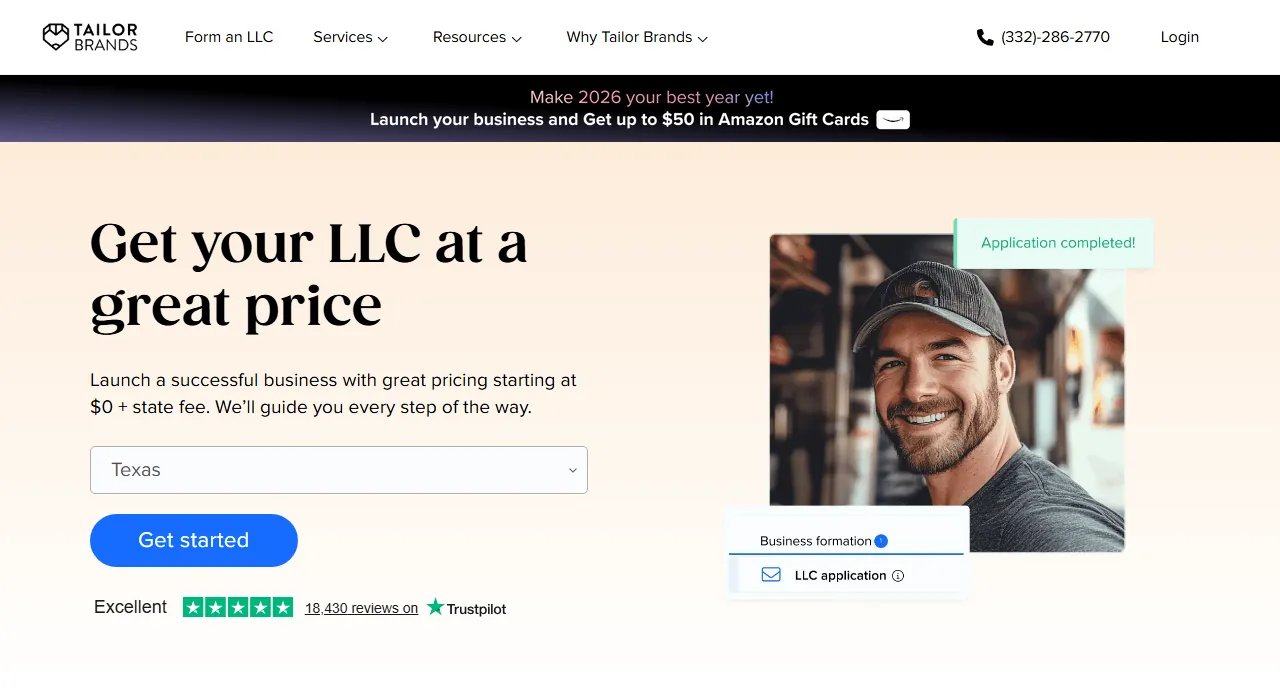
Doing this through Tailor Brands swaps the state form for a short questionnaire. Here's what we saw when we went through it on November 27, 2026, stopping before account creation and payment: Receipt · Tailor Brands sign-up flow (gone through up to account creation)The sign-up screens and their orderRead Nov 27, 2026Open source ↗
-
1
Pick your state
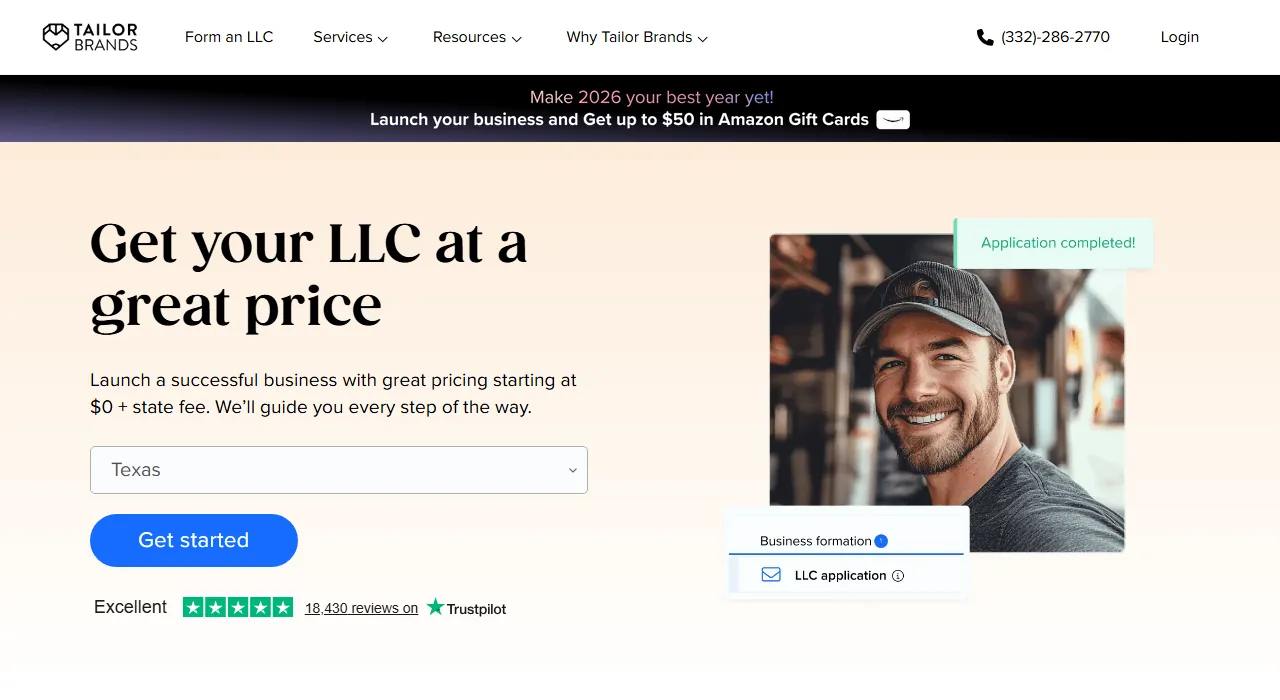
On the pricing page, choose your state from the menu and hit Get started. Receipt · Tailor Brands sign-up flow (gone through up to account creation)The sign-up screens and their orderRead Nov 27, 2026Open source ↗
-
2
Type your business name
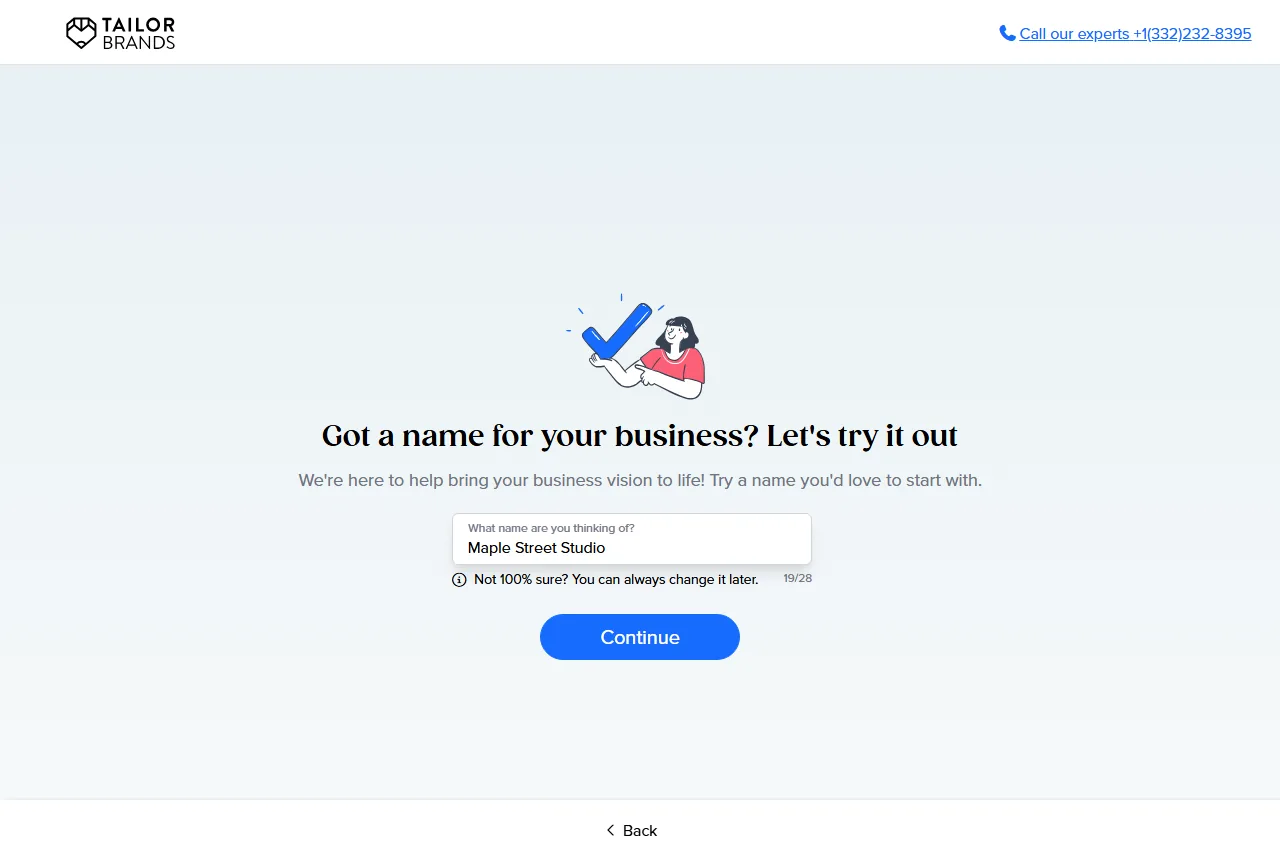
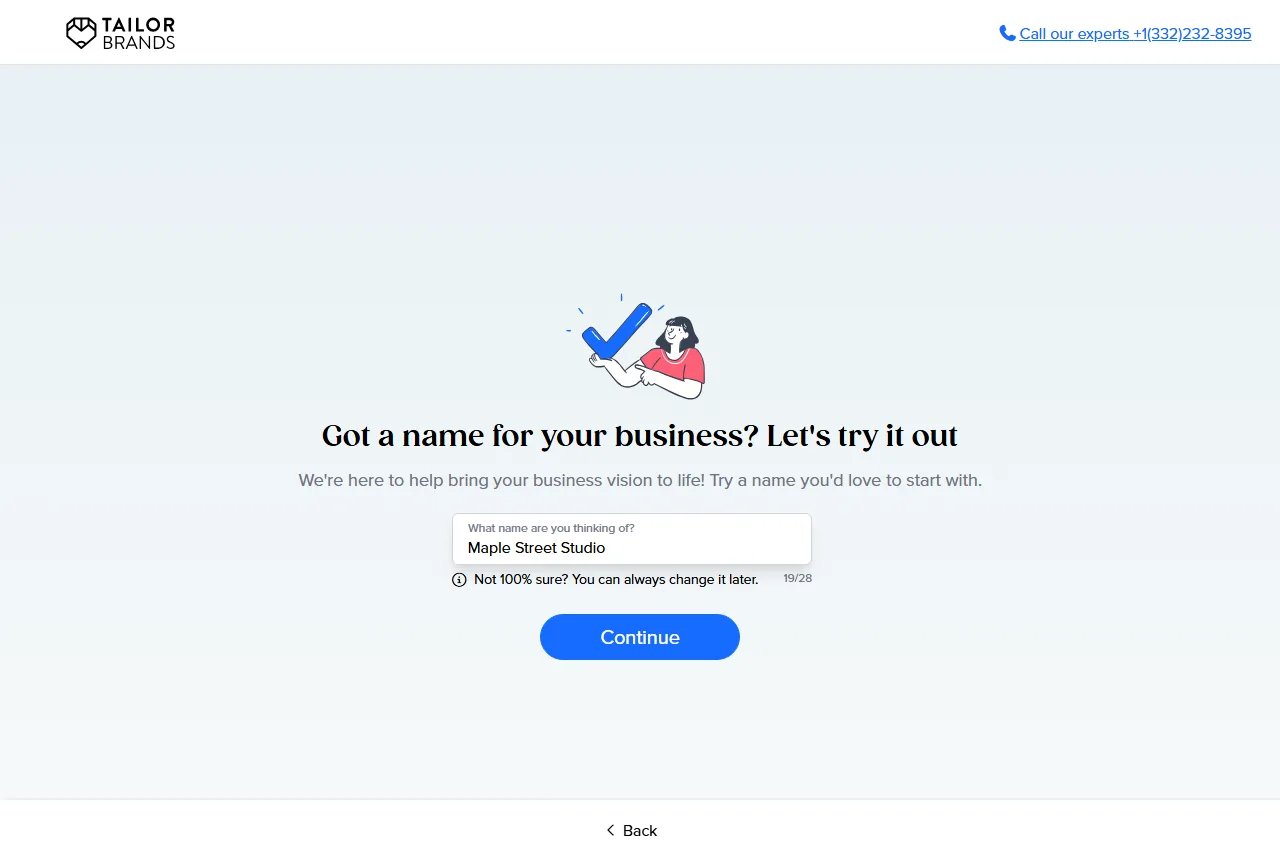
One field, 28 characters max. The screen says you can change it later. Receipt · Tailor Brands sign-up flow (gone through up to account creation)The sign-up screens and their orderRead Nov 27, 2026Open source ↗
-
3
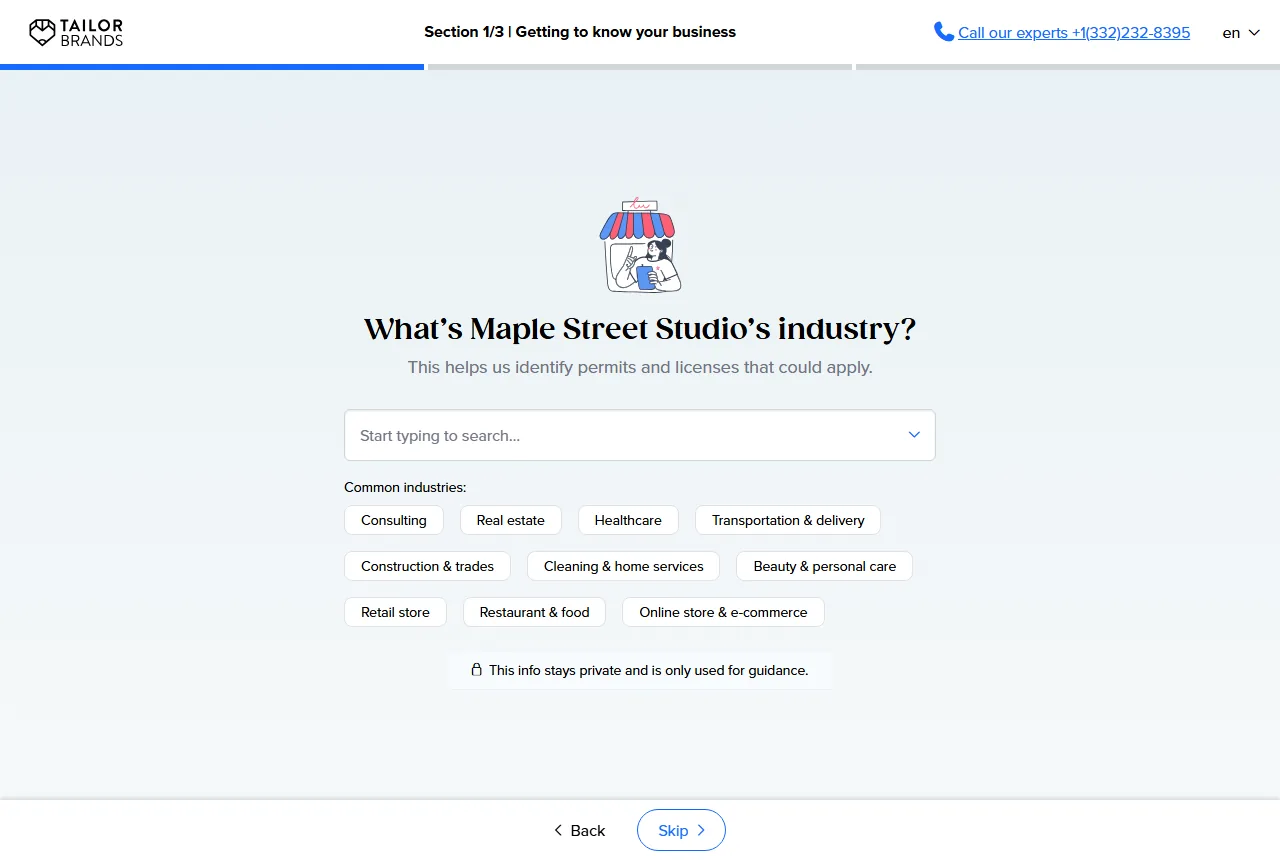
Pick your industry
Ten common industries as buttons, or type your own. They use it to flag permits and licenses that might apply. You can skip it. Receipt · Tailor Brands sign-up flow (gone through up to account creation)The sign-up screens and their orderRead Nov 27, 2026Open source ↗
-
4
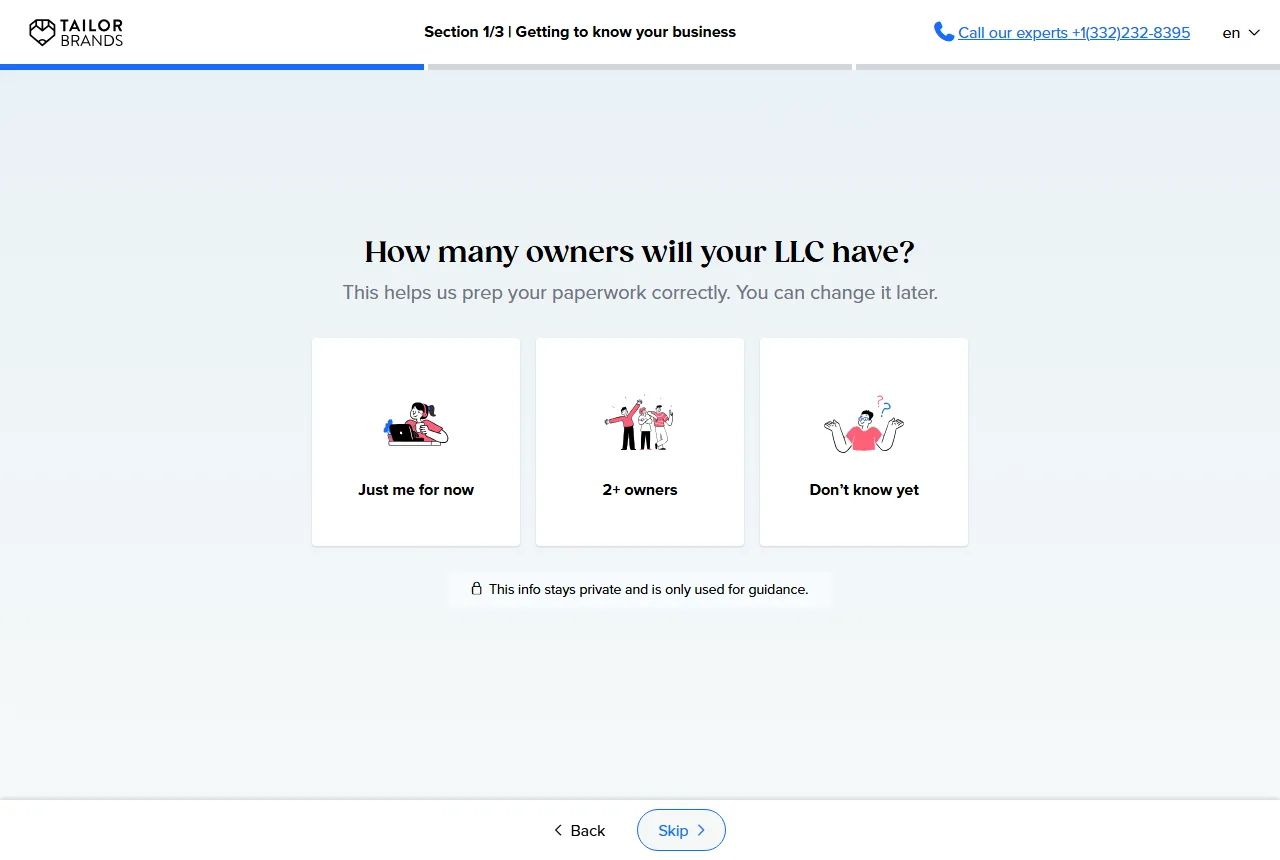
Answer three quick questions
Where you are (just an idea, first steps, getting ready, already in business), whether it's your first business, and how many owners. Each screen has a Skip button. Receipt · Tailor Brands sign-up flow (gone through up to account creation)The sign-up screens and their orderRead Nov 27, 2026Open source ↗
-
5
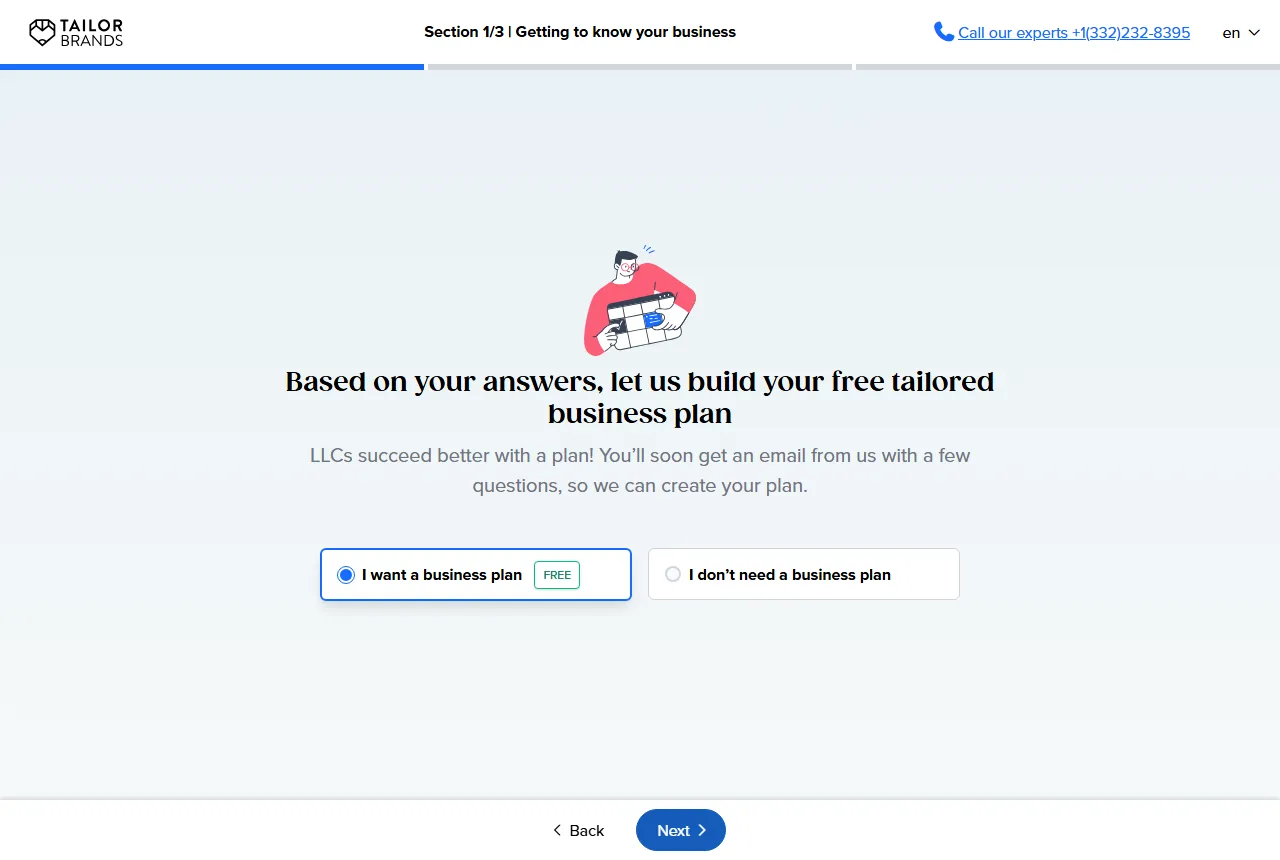
Free business plan, yes or no
An optional free tailored business plan. You can decline it and keep going. Receipt · Tailor Brands sign-up flow (gone through up to account creation)The sign-up screens and their orderRead Nov 27, 2026Open source ↗
-
6
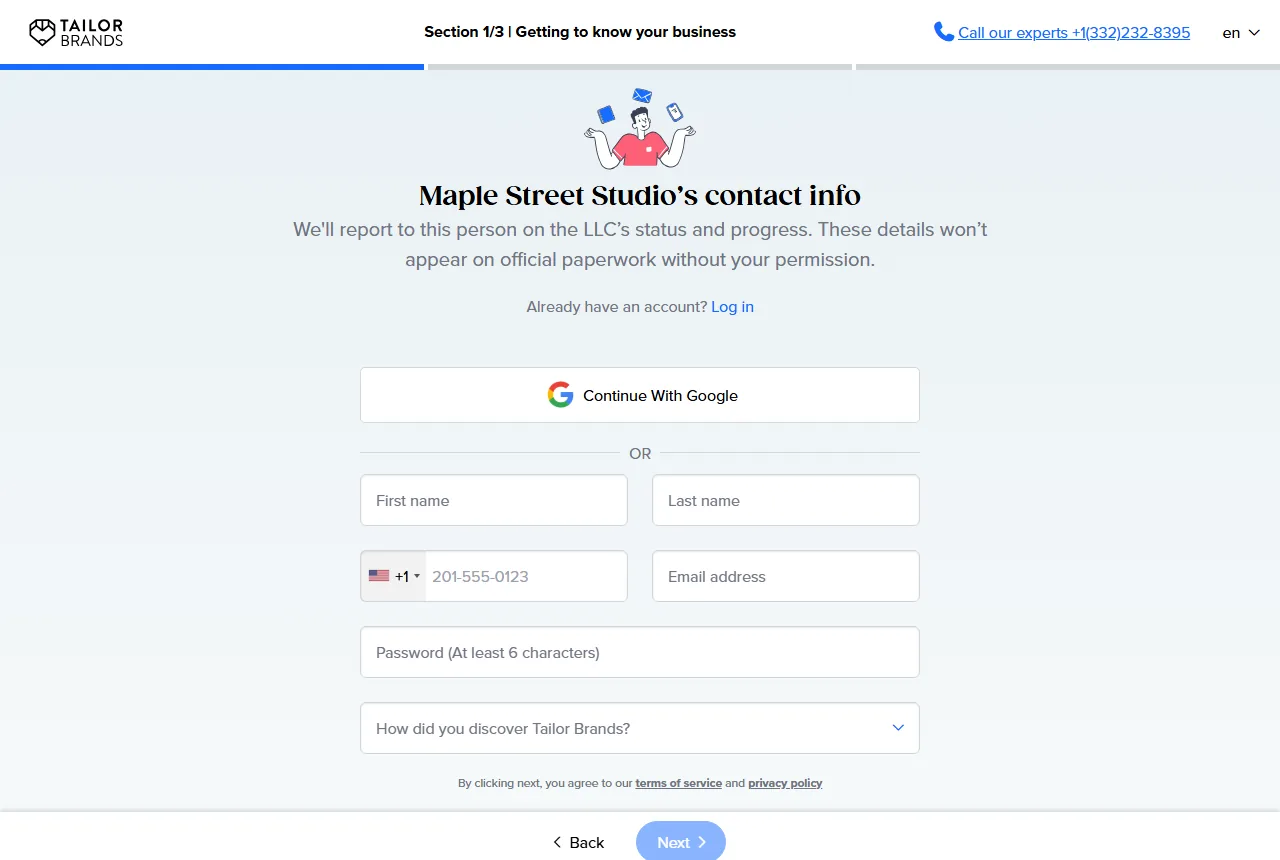
Create your account
Name, phone, email and a password, or Continue with Google. Plan choice and payment come after this screen. Receipt · Tailor Brands sign-up flow (gone through up to account creation)The sign-up screens and their orderRead Nov 27, 2026Open source ↗
Tailor Brands files your Articles of Organization for $0 on the Lite plan. You still pay your state's fee.
Step 5: Do you need an operating agreement?
An operating agreement sets out who owns what, how decisions get made, how profits and losses are split, and what happens if a member wants out. You keep it with your records; it isn't filed with the state. Receipt · Tailor Brands: How to start an LLCThe steps, fee ranges, agent and name rules, operating agreement, BOI changeRead Nov 27, 2026Open source ↗
Most states don't require a written one, but a few do, New York among them. Write one anyway, even as a single-member LLC: banks often ask for it, and it's the document that settles arguments between members before they start. Templates and what to put in it: LLC operating agreement guide. Receipt · Tailor Brands: How to start an LLCThe steps, fee ranges, agent and name rules, operating agreement, BOI changeRead Nov 27, 2026Open source ↗
On Tailor Brands, an operating agreement comes with the Essential and Elite plans. It isn't part of Lite. Receipt · Tailor Brands pricing pageLite $0, Essential $199/yr, Elite $249/yr, add-ons ($199 agent, $99 EIN, $39/mo bookkeeping)Read Nov 27, 2026Open source ↗
Step 6: How do you get an EIN for your LLC?
An Employer Identification Number (EIN) is your business's federal tax ID. You need one to hire employees or run a multi-member LLC, and most banks ask for one before they'll open a business account. Receipt · Tailor Brands: How to start an LLCThe steps, fee ranges, agent and name rules, operating agreement, BOI changeRead Nov 27, 2026Open source ↗
Get it straight from the IRS. The IRS is blunt about it: you never have to pay a fee for an EIN. Its online tool issues the number right away if the application is approved. Form the LLC with your state first, then apply. Receipt · IRS: Get an employer identification numberEIN is free, who can apply online, hours, daily limitRead Nov 27, 2026Open source ↗
- Online works if your business is based in the U.S. and the responsible party has an SSN or ITIN. Receipt · IRS: Get an employer identification numberEIN is free, who can apply online, hours, daily limitRead Nov 27, 2026Open source ↗
- Finish in one sitting: the session times out after 15 minutes of inactivity, and you can't save it for later. Receipt · IRS: Get an employer identification numberEIN is free, who can apply online, hours, daily limitRead Nov 27, 2026Open source ↗
- Hours (Eastern): Mon–Fri 6 a.m. to 1 a.m., Sat 6 a.m. to 9 p.m., Sun 6 p.m. to midnight. One EIN per responsible party per day. Receipt · IRS: Get an employer identification numberEIN is free, who can apply online, hours, daily limitRead Nov 27, 2026Open source ↗
- Based outside the U.S.? The online tool won't work. Apply by phone, fax or mail. Receipt · IRS: Get an employer identification numberEIN is free, who can apply online, hours, daily limitRead Nov 27, 2026Open source ↗
Tailor Brands sells EIN filing as an add-on at $99. That's a convenience fee for doing the form for you; the number itself is free. Full walkthrough: how to get an EIN number. Receipt · Tailor Brands pricing pageLite $0, Essential $199/yr, Elite $249/yr, add-ons ($199 agent, $99 EIN, $39/mo bookkeeping)Read Nov 27, 2026Open source ↗
Step 7: Should your LLC have its own bank account?
Neither state nor federal law makes you open one. Open it anyway. Mixing personal and business money can put the liability protection you just paid for at risk, and a separate account makes bookkeeping and tax time far simpler. Receipt · Tailor Brands: How to start an LLCThe steps, fee ranges, agent and name rules, operating agreement, BOI changeRead Nov 27, 2026Open source ↗
Bring your approved formation document, your EIN and usually your operating agreement. What each bank asks for, and how to pick one: how to open a business bank account. Receipt · Tailor Brands: How to start an LLCThe steps, fee ranges, agent and name rules, operating agreement, BOI changeRead Nov 27, 2026Open source ↗
Step 8: What do you have to do after the LLC is approved?
Forming the LLC is a one-time job. Keeping it in good standing is a yearly one. Receipt · Tailor Brands: How to start an LLCThe steps, fee ranges, agent and name rules, operating agreement, BOI changeRead Nov 27, 2026Open source ↗
- Licenses and permits: depending on what you do and where, you may need a city or county business license, a sales tax permit or industry permits. The SBA's licenses guide is a good starting point. Receipt · SBA: Launch your businessStructure choice, value of counselors, licensesRead Nov 27, 2026Open source ↗
- Annual or biennial report: most states want one, often around your formation anniversary, from $0 to $500 a year. Miss it and the state can add late fees and eventually dissolve your LLC. Receipt · Tailor Brands: How to start an LLCThe steps, fee ranges, agent and name rules, operating agreement, BOI changeRead Nov 27, 2026Open source ↗
- State taxes and fees: franchise tax, annual LLC tax or sales tax, depending on the state. Texas wants a franchise tax report by May 15 even when no tax is due. Receipt · Texas Comptroller: Franchise taxReport due May 15, $2.65M no-tax-due thresholdRead Nov 27, 2026Open source ↗
- BOI reports: since March 2025, LLCs formed in the U.S. no longer have to file beneficial ownership information reports with FinCEN. Receipt · Tailor Brands: How to start an LLCThe steps, fee ranges, agent and name rules, operating agreement, BOI changeRead Nov 27, 2026Open source ↗
The SBA also says that talking to business counselors, attorneys and accountants can prove helpful when you choose a structure. That's especially true once taxes come into it. Receipt · SBA: Launch your businessStructure choice, value of counselors, licensesRead Nov 27, 2026Open source ↗
Should you file the LLC yourself or use a service?
Filing yourself costs only the state fee. You read the state's instructions, fill out the form, pick an agent and file. If you're organized and your state has a good online portal, it's very doable. We cover the $0-service route in how to start an LLC for free. Receipt · Tailor Brands: How to start an LLCThe steps, fee ranges, agent and name rules, operating agreement, BOI changeRead Nov 27, 2026Open source ↗
A service earns its keep when you'd rather answer plain-English questions than decode a state form, or when you want the EIN, agent, compliance reminders and branding handled in one dashboard. Here's what Tailor Brands charges, read on its pricing page today: Receipt · Tailor Brands pricing pageLite $0, Essential $199/yr, Elite $249/yr, add-ons ($199 agent, $99 EIN, $39/mo bookkeeping)Read Nov 27, 2026Open source ↗
First LLC, tight budget, you'll handle the extras yourself
- LLC formation filed for you
- Bookkeeping: free 30-day trial
- Business coaching platform
- Sales & payments tools
You want the operating agreement and the annual report handled
- Everything in Lite
- Priority order processing
- Operating agreement
- Annual compliance: report filing and updates
- Funding search
- $30 Amazon gift card
You're building the brand and website now, not later
- Everything in Essential
- 1-year free domain
- DIY website and online store
- Logos, digital business card, social post maker
- $50 Amazon gift card
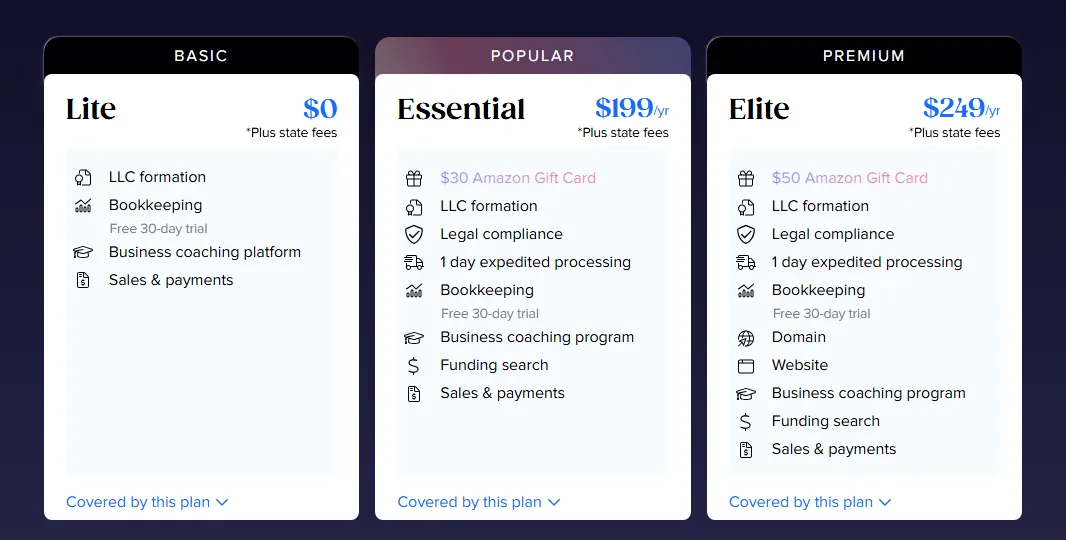
Add-ons are listed separately: registered agent $199 a year, EIN filing $99, and the bookkeeping trial turns into $39 a month after 30 days unless you cancel. Tailor Brands also notes that the binding price is the one shown at checkout. The full breakdown is in our Tailor Brands review, and we compare the other big names in the best LLC services. Receipt · Tailor Brands pricing pageLite $0, Essential $199/yr, Elite $249/yr, add-ons ($199 agent, $99 EIN, $39/mo bookkeeping)Read Nov 27, 2026Open source ↗
If your state has a simple online portal and you already have your own registered agent address, filing directly with the state is the cheapest path, and Tailor Brands' own site says you're free to do that.
What does starting an LLC really cost, all in?
Add up three layers. First, the state fee (from $70 in California to $300 in Texas in our table). Second, any ongoing state cost for year one, like California's $800 or Florida's $138.75 report. Third, what you choose to pay a service for: $0 on Tailor Brands Lite, plus any add-on you tick, such as a $199 registered agent. Receipt · Tailor Brands pricing pageLite $0, Essential $199/yr, Elite $249/yr, add-ons ($199 agent, $99 EIN, $39/mo bookkeeping)Read Nov 27, 2026Open source ↗
| Setup | State fee | Tailor Brands | Registered agent | EIN | Total |
|---|---|---|---|---|---|
| Wyoming, you are your own agent | $100 | $0 | $0 | $0 (IRS) | $100 |
| Florida, Tailor Brands agent | $125 | $0 | $199/yr | $0 (IRS) | $324 |
| Texas, Tailor Brands agent + EIN add-on | $300 | $0 | $199/yr | $99 | $598 |
Receipt · Wyoming Secretary of State: Business fee schedule$100 Articles of Organization, $60 minimum annual report taxRead Nov 27, 2026Open source ↗ Receipt · Florida Division of Corporations: Articles of Organization (CR2E047)$125 filing fee incl. agent designation, $138.75 annual report, $400 late feeRead Nov 27, 2026Open source ↗ Receipt · Texas Secretary of State: Form 205 Certificate of Formation$300 filing feeRead Nov 27, 2026Open source ↗ Receipt · Tailor Brands pricing pageLite $0, Essential $199/yr, Elite $249/yr, add-ons ($199 agent, $99 EIN, $39/mo bookkeeping)Read Nov 27, 2026Open source ↗ Receipt · IRS: Get an employer identification numberEIN is free, who can apply online, hours, daily limitRead Nov 27, 2026Open source ↗
These totals leave out ongoing state costs that come later in the year (Wyoming's report tax, Florida's annual report) and anything you add at checkout. Use them as a floor, not a quote.
For most first-time owners: form the LLC in the state where you live, write an operating agreement even if it's optional, and get your EIN free from the IRS. If you'd rather not deal with the state form, Tailor Brands' Lite plan files it for $0 plus the state fee, and you only pay for the add-ons you actually tick.